Wandering Through Mumbai’s Soul: Where Landmarks Tell Stories
You know that feeling when a city just speaks to you? Mumbai did exactly that—through the echo of footsteps on colonial stone, the glow of art deco facades at sunset, and the quiet pride in every monument. I wandered with no map, just curiosity, and found myself face to face with history, architecture, and the pulse of India’s boldest city. These aren’t just buildings—they’re living chapters of a story you gotta experience. In a metropolis of 20 million, where life moves at full throttle, the landmarks stand as anchors of memory, identity, and beauty. They remind us that even in chaos, there is harmony; even in progress, there is preservation.
The Spirit of Wandering in a Megacity
Mumbai does not reveal itself all at once. It unfolds slowly, like a well-kept secret whispered over chai at a roadside stall. To truly understand this city, one must resist the urge to check off landmarks from a list. Instead, the most meaningful discoveries come from wandering—allowing the rhythm of the streets to guide your steps. There is a kind of wisdom in getting lost here, where every alleyway might open into a colonial courtyard, and every turn could bring you face to face with a centuries-old temple tucked between modern shops. The city pulses with a raw, unfiltered energy—trains thunder past, vendors call out their wares, children play cricket on narrow sidewalks, and families gather on sea-facing benches as the sun dips below the Arabian Sea.
This is not a city built for silence or solitude, yet within its clamor lies a deep sense of connection. The act of wandering becomes a form of listening. You begin to notice how people interact with their surroundings—not just passing through, but belonging to the spaces they inhabit. A grandmother adjusts her sari while walking past a British-era post office; a group of students sketches the façade of a heritage building for an architecture class; a street performer sings near a monument as if offering music to history itself. These moments are not staged for tourists. They are real, daily rituals that breathe life into Mumbai’s landmarks.
What sets Mumbai apart from other global cities is its ability to balance urgency with intimacy. Life moves fast, but human warmth remains constant. A guided tour may tell you the facts about a monument—the year it was built, the architect’s name, the style of construction. But only wandering allows you to feel the weight of time, to sense how generations have walked these same paths, leaving traces of their lives in the worn stone steps and weathered walls. It is in these unscripted encounters that the soul of Mumbai emerges—not in grand gestures, but in quiet details.
Chhatrapati Shivaji Maharaj Terminus: A Gateway to the Past
One cannot speak of Mumbai’s landmarks without beginning at Chhatrapati Shivaji Maharaj Terminus (CSMT), formerly known as Victoria Terminus. This is not merely a railway station; it is a living monument to the city’s colonial past and its enduring spirit of movement. Designed by British architect F.W. Stevens and completed in 1887, the structure blends Victorian Gothic Revival architecture with Indian decorative elements, creating a unique fusion that reflects the cultural crossroads Mumbai has always been. Recognized as a UNESCO World Heritage Site, CSMT stands as both a functional transit hub and a masterpiece of 19th-century engineering and artistry.
The first glimpse of the building is nothing short of breathtaking. Soaring turrets, pointed arches, and a central dome rise above the bustling streets, drawing the eye upward. The façade is richly adorned with carvings of animals, flora, and mythological figures—each telling a story, each contributing to the grand narrative of imperial ambition and local craftsmanship. Inside, the high vaulted ceilings and stained-glass windows filter sunlight into soft patterns across the marble floors. Yet, despite its cathedral-like beauty, this is no museum. It is very much alive, with over three million commuters passing through its halls every day.
Walking through CSMT is an experience of contrasts. The quiet elegance of its architecture exists in constant dialogue with the noise and motion of modern travel. Porters rush by with luggage stacked high, office workers weave through crowds with practiced ease, and vendors sell tea and snacks beneath ornate chandeliers. There is a sacredness to the space—not in a religious sense, but in the way it honors the journey. Every footstep echoes through corridors that have witnessed over a century of arrivals and departures, of reunions and farewells. This is where Mumbai’s story began in many ways—not just as a port city, but as a place of connection, migration, and dreams.
To stand in the central hall and look up at the dome is to feel small in the best possible way. It is a humbling reminder of time’s passage and the collective human effort that built this city. The station does not belong to any single era—it belongs to everyone who has ever passed through it. Whether you are a local returning home after work or a visitor stepping into Mumbai for the first time, CSMT welcomes you with the same quiet dignity. It is not just a gateway to the city; it is a gateway to understanding it.
The Art Deco Charm of Marine Drive
If CSMT represents Mumbai’s colonial grandeur, then Marine Drive embodies its modern aspirations. Stretching along the western coastline in a graceful curve, this 3.6-kilometer promenade is flanked by a row of elegant Art Deco apartment buildings constructed primarily in the 1930s. Known affectionately as the “Queen’s Necklace” for the way its streetlights glow like jewels at night, Marine Drive offers one of the most iconic views in the city. But beyond the postcard-perfect scenery lies a deeper architectural and cultural significance.
The Art Deco movement, which originated in France and flourished globally in the early 20th century, found a unique expression in Mumbai. Here, the style was adapted to the tropical climate and local tastes, resulting in what is now recognized as the world’s second-largest collection of Art Deco buildings, after Miami. The apartments along Marine Drive feature streamlined forms, geometric patterns, and nautical motifs—porthole windows, ship deck railings, and wave-like balconies that echo the nearby sea. These were not just homes; they were symbols of progress, optimism, and cosmopolitan living during a time when India was on the cusp of independence.
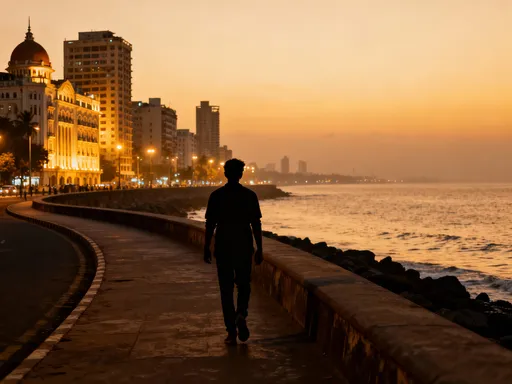
Walking along the promenade at dusk is one of Mumbai’s simplest yet most profound pleasures. The air carries the salt of the Arabian Sea, the sky shifts from gold to deep orange, and the first lights flicker on in the apartments above. Families gather on benches, couples stroll hand in hand, and elderly residents practice yoga or tai chi in quiet corners. This is a space for leisure, reflection, and community—a rare urban oasis where people from all walks of life come together simply to be.
What makes Marine Drive truly special is that it remains a lived-in heritage site. Unlike many historic districts that become museum pieces, these buildings are still homes. Children play in the lobbies, laundry flutters from balconies, and the scent of evening meals drifts through open windows. This continuity—between past and present, between architecture and daily life—is what gives the area its soul. It is not preserved behind glass; it is alive, evolving, and deeply cherished by those who call it home.
Gateway of India: Where History Meets the Present
Rising from the waterfront near the Apollo Bunder, the Gateway of India is perhaps Mumbai’s most photographed landmark. Built in 1924 to commemorate the visit of King George V and Queen Mary, the structure is a blend of Indo-Saracenic and Muslim architectural styles, featuring horseshoe arches, turrets, and intricate latticework. Though originally intended as a symbol of British imperial power, the Gateway took on new meaning in 1948, when the last British troops departed India through this very spot. Today, it stands as a monument to transition—a bridge between eras, identities, and narratives.
The Gateway is more than just stone and symmetry. It is a place of gathering, celebration, and quiet contemplation. Tourists arrive in droves to take photos beneath its grand arch, while local families spread out on the surrounding steps, sharing snacks and stories. Street vendors sell cotton candy, seashell jewelry, and cold coconut water, adding color and sound to the scene. Boats depart from the nearby jetty for Elephanta Island, carrying visitors to ancient cave temples, linking the present-day city with its distant past.
Standing beneath the arch and looking out over the harbor, one cannot help but reflect on the layers of history embedded in this single location. Ships have sailed in and out of this port for centuries—traders, colonizers, pilgrims, and migrants—all leaving their mark on Mumbai’s identity. The Gateway does not glorify any one chapter; instead, it acknowledges them all. It is a space that belongs to everyone, shaped by collective memory and shared experience.
In recent years, the area around the Gateway has undergone careful restoration, with improved lighting, cleaner walkways, and better access for pedestrians. These changes have enhanced the visitor experience without compromising the site’s authenticity. It remains a place where history feels tangible, where the past is not locked away in textbooks but lived in the rhythm of daily life. To stand here is to witness Mumbai’s ability to honor its roots while embracing the future.
Haji Ali Dargah: Faith and Form in Harmony
One of Mumbai’s most striking spiritual sites, the Haji Ali Dargah, appears to float on the surface of the Arabian Sea. Dedicated to the Sufi saint Pir Haji Ali Shah Bukhari, the mosque and tomb are accessible via a 500-meter causeway that emerges from the mainland at Worli. The structure’s whitewashed domes and minarets shimmer in the sunlight, creating a vision of serenity amidst the city’s relentless pace. Built in the 15th century and later rebuilt in the 19th, the dargah is a masterpiece of Indo-Islamic architecture, blending Persian, Arab, and Indian design elements.
The journey to the dargah is part of its spiritual significance. The causeway is only passable during low tide, meaning visitors must time their arrival carefully. As you walk toward the shrine, the sea stretches out on both sides, creating a sense of isolation and introspection. The sound of waves, the call to prayer echoing from the minarets, and the sight of devotees in prayer all contribute to an atmosphere of deep reverence. Men and women enter through separate gates, and all visitors are expected to dress modestly—removing shoes and covering their heads—as a sign of respect.
Inside the complex, the air is filled with the scent of incense and roses. The tomb is draped in green silk, embroidered with verses from the Quran, and surrounded by flickering oil lamps. Devotees offer chadors (ceremonial cloths) and flowers, believing that their prayers will be heard by the saint. While the dargah is a Muslim shrine, it welcomes people of all faiths, reflecting Mumbai’s long tradition of religious tolerance and coexistence.
The dargah is not just a place of worship; it is also a symbol of resilience. Over the years, it has faced threats from rising sea levels and coastal erosion, prompting conservation efforts to protect its foundation. These preservation attempts highlight the importance of safeguarding cultural and spiritual heritage in the face of environmental challenges. For many Mumbaikars, the dargah is more than a monument—it is a source of comfort, hope, and continuity in an ever-changing world.
Modern Icons: From Antilia to the New Mumbai Skyline
As the sun sets behind Marine Drive, the eastern skyline of Mumbai begins to sparkle with the lights of modern high-rises. In the Bandra-Kurla Complex (BKC), one of the city’s fastest-growing business districts, glass towers rise like vertical cities, housing multinational corporations, luxury hotels, and cutting-edge infrastructure. Among them stands Antilia, the 27-story private residence of one of India’s wealthiest families. With its futuristic design, helipads, and multiple sky gardens, the building has become a symbol of India’s economic ascent and the ambitions of its urban elite.
While some view such structures as symbols of inequality, others see them as testaments to innovation and progress. The contrast between Antilia and the surrounding neighborhoods—where informal settlements and modest homes coexist with corporate offices—reflects the complexities of Mumbai’s development. Yet, rather than erasing the past, the new skyline engages in a dialogue with it. Architects increasingly incorporate traditional motifs, sustainable materials, and climate-responsive designs into their work, ensuring that modernity does not come at the cost of identity.
BKC itself is a model of planned urban growth. With wide roads, green spaces, and efficient public transport links, it offers a glimpse of what a more organized, livable Mumbai could look like. New cultural centers, such as the Nita Mukesh Ambani Cultural Centre, are also emerging, hosting performances, exhibitions, and educational programs that celebrate Indian arts and heritage. These developments suggest that economic growth and cultural preservation are not mutually exclusive—they can, and must, grow together.
The skyline is no longer just a backdrop; it is a statement. It says that Mumbai is moving forward, embracing technology, globalization, and change. But it also says that the city remembers where it came from. In the shadow of these glass towers, the old landmarks still stand—CSMT, Marine Drive, the Gateway—unshaken, unbroken, and more meaningful than ever.
Wandering with Purpose: Tips for Meaningful Exploration
Exploring Mumbai’s landmarks is not just about seeing them—it’s about experiencing them. To make the most of your journey, a few practical considerations can make a big difference. The best time to visit is between November and February, when the weather is cooler and less humid. Mornings and late afternoons are ideal for walking, especially along Marine Drive or near the Gateway, where the light is soft and the crowds are smaller.
Wear comfortable, breathable clothing and sturdy walking shoes. Many streets are uneven, and some heritage sites require climbing stairs or standing for long periods. Always carry a reusable water bottle—staying hydrated is essential in Mumbai’s tropical climate. Public drinking fountains are limited, but many cafes and shops are happy to refill bottles for visitors.
When visiting religious sites like Haji Ali Dargah, dress respectfully and follow local customs. Avoid visiting during prayer times if you are not participating, and always ask permission before taking photographs of people. Engage with locals when possible—many are happy to share stories about their neighborhoods, favorite eateries, or hidden architectural details that guidebooks often miss.
Slow down. Resist the urge to rush from one landmark to the next. Sit on a bench at Marine Drive and watch the city breathe. Stand quietly inside CSMT and listen to the echoes of footsteps. Let the architecture speak to you. Take notes, sketch, or simply observe. The most meaningful travel is not measured in miles covered, but in moments noticed.
Buildings That Breathe
Mumbai’s landmarks are not frozen in time. They are dynamic, evolving, and deeply intertwined with the lives of those who live among them. From the grandeur of Chhatrapati Shivaji Maharaj Terminus to the quiet grace of Haji Ali Dargah, from the nostalgic charm of Marine Drive to the bold silhouette of the new skyline, each structure tells a story—of empires, of faith, of resilience, of dreams.
To wander through Mumbai is to engage in a conversation with history. It is to recognize that cities are not just made of steel and stone, but of memory, movement, and meaning. The landmarks do not stand apart from the people; they exist because of them. They are shaped by daily rituals, by generations of footsteps, by the quiet acts of devotion, work, and love that unfold beneath their arches and within their walls.
In a world that often moves too fast, Mumbai teaches us to pause, to look closely, to listen. Its monuments do not shout—they whisper. And if you walk with an open heart, you will hear them. You will feel the weight of the past, the pulse of the present, and the promise of the future. That is the true magic of this city. It does not just show you its landmarks—it lets them speak to you.